Most collagen isn’t halal. Here’s how to spot the ones that are — and pick the right type for glowing skin or healthy joints.
Short answer: most collagen is not halal — but some is. Collagen is an animal protein. If it comes from pork, it’s haram. If it comes from cattle, it’s only halal when the animal was slaughtered the halal way and the product is certified. Marine (fish) collagen is halal by default. So the question isn’t really “is collagen halal?” — it’s which collagen, and can you prove it?
Collagen is one of the most bought supplements in the world for skin, hair, nails and joints. It’s also one of the hardest to buy if you keep halal, because the label rarely tells you what you actually need to know — most brands print the benefits in big letters and bury the source in the small print. This guide fixes that in about five minutes. We’ll cover where collagen actually comes from, the checks that reveal whether a product is genuinely halal, the one thing even careful shoppers miss, and how to choose the right type for your goal.
Why collagen is a special case
Most vitamins and minerals are simple to buy halal. Vitamin C, creatine, magnesium and many others are produced in a lab from non-animal materials, so they’re permissible by default no matter which brand you pick. Collagen is different, and the reason matters: it can’t be made synthetically. It has to be extracted from an animal, which means the source and the way that animal was handled suddenly decide whether the whole product is halal or not.
That’s why two tubs sitting next to each other on the same shelf — same “collagen peptides” on the label, same promises about skin and joints — can have completely different halal status. It comes down to which animal the collagen was taken from. There are three possible sources, and they are not equal:
- Porcine (pig) collagen — cheap, common, and always haram. No exceptions.
- Bovine (cattle) collagen — permissible only if the cattle were halal-slaughtered (zabiha) and the product is certified. Standard bovine collagen usually isn’t, so it can’t be assumed halal.
- Marine (fish) collagen — halal by default. All four Sunni schools agree fish needs no special slaughter, so marine collagen carries no slaughter question.
In other words, the collagen molecule itself is never the problem. The animal it came from, and how it was slaughtered and handled, are the only things that decide the answer — which is exactly why the label wording deserves a closer look than most people give it.
The catch even careful shoppers miss: processing
Say you’ve done everything right — you’ve chosen marine collagen, or certified bovine, and you’re confident about the source. There’s still one more layer that most articles skip entirely, and it happens after the animal: manufacturing. Even a permissible source can be quietly compromised on the production line in three ways:
- Enzymes and processing aids used to hydrolyse the collagen aren’t always halal.
- Shared production lines can cross-contaminate with non-halal products made in the same facility.
- Add-ons — some flavoured collagens and shots contain carmine (an insect-derived red colour) or alcohol-based flavourings.
This is exactly why a self-declared “suitable for halal” line on the front of a pack isn’t enough on its own. That claim usually only speaks to the source, not to everything that happened afterwards. Only proper third-party certification covers the whole chain — source, slaughter, processing and packaging — which is the difference between a product that’s marketed as halal and one that’s actually been checked.
After years of reading ingredient lists and still not being 100% sure, having a properly certified collagen is such a relief. It’s the first one I actually trust.
Verified buyer · Kollagen Support PLUS+
Marine or bovine? Pick by your goal
Once you’re looking at genuinely halal options, the next question is which type suits you — because marine and bovine collagen aren’t interchangeable. They contain different collagen types and are absorbed differently, so the right pick depends on what you actually want to improve rather than on which one is “better” overall. The simple rule of thumb: if your focus is skin, hair and nails, go marine; if you also care about joints, go for certified bovine. Here’s how the two compare side by side:
How to check any collagen label in under a minute
You don’t need to be an expert to vet a collagen — you just need to know what to look for and in what order. Next time you’re holding a tub or scrolling a product page, run through these five checks. They take less than a minute and rule out almost every non-halal product before you even get to the price:
- Find the source. Look for “marine / fish” or “bovine.” If it just says “collagen peptides” with no animal named, treat it as unclear.
- Rule out pork. “Porcine” = pig = haram.
- For bovine, demand certification. Bovine is halal only with a “halal certified” mark. No certificate = don’t assume.
- Check the extras. Natural flavour and “no added sugar” are good signs; watch for carmine and alcohol-based flavourings in shots.
- Look for the certifying body. A real halal claim names an issuer. A vague “halal-friendly” with no issuer is a soft claim, not proof.
How Darajo handles it
Collagen is our bestseller, and everything above is the reason we built it the way we did. Rather than pick one source and hope it fits everyone, we offer both halal routes — marine and certified bovine — so you can choose by your goal. Both are halal certified end to end, lab tested, and come as an easy daily wild-berry shot.
Kollagen Marine Plus — for skin, hair & nails
Key feature: Marine (fish) collagen at 1500 Dalton, small enough to absorb directly. Type 1 & 3 with hyaluronic acid, biotin and vitamin C.
How to take: One 10ml shot daily on an empty stomach. Halal certified, no added sugar, lab tested. Results typically visible after 4–6 weeks.
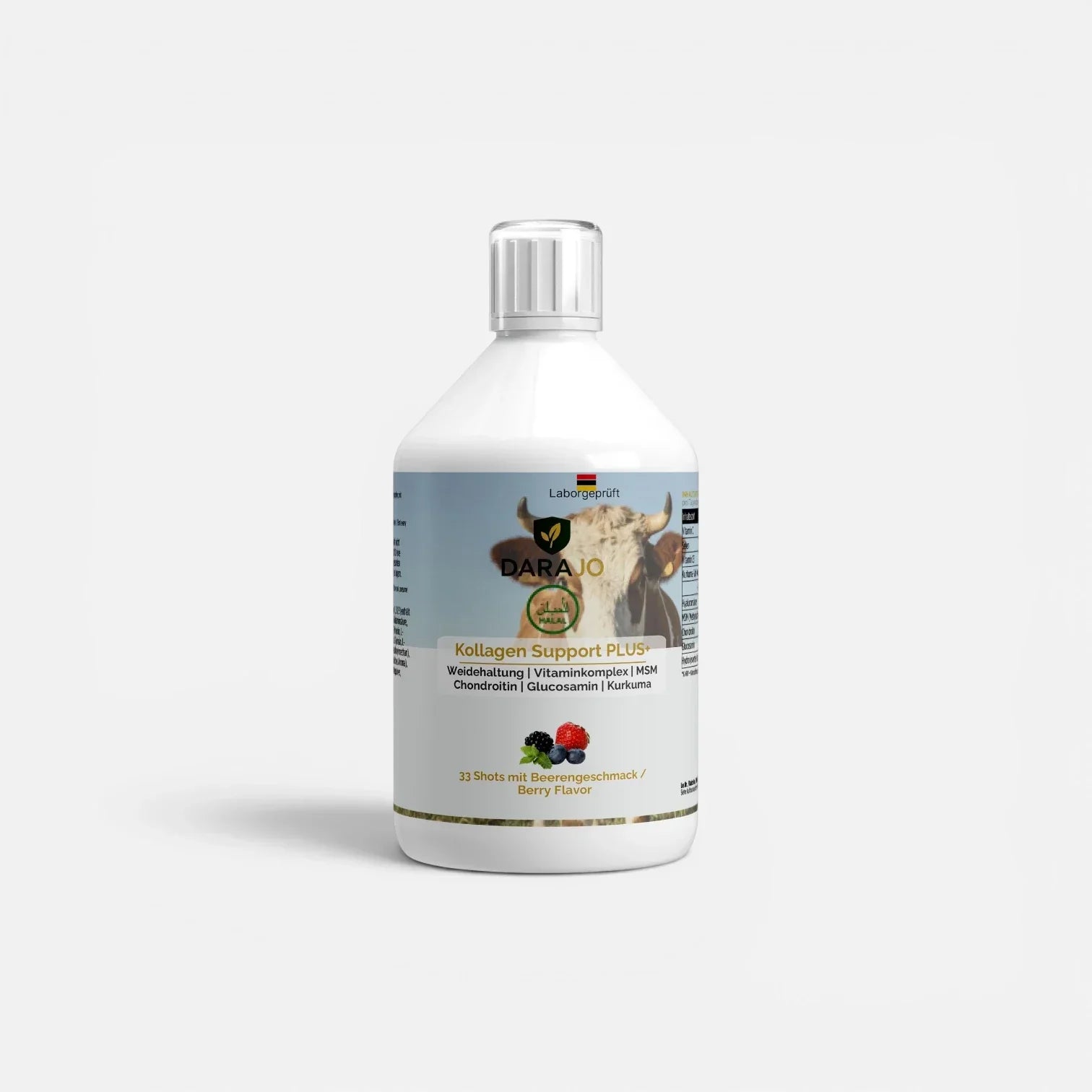
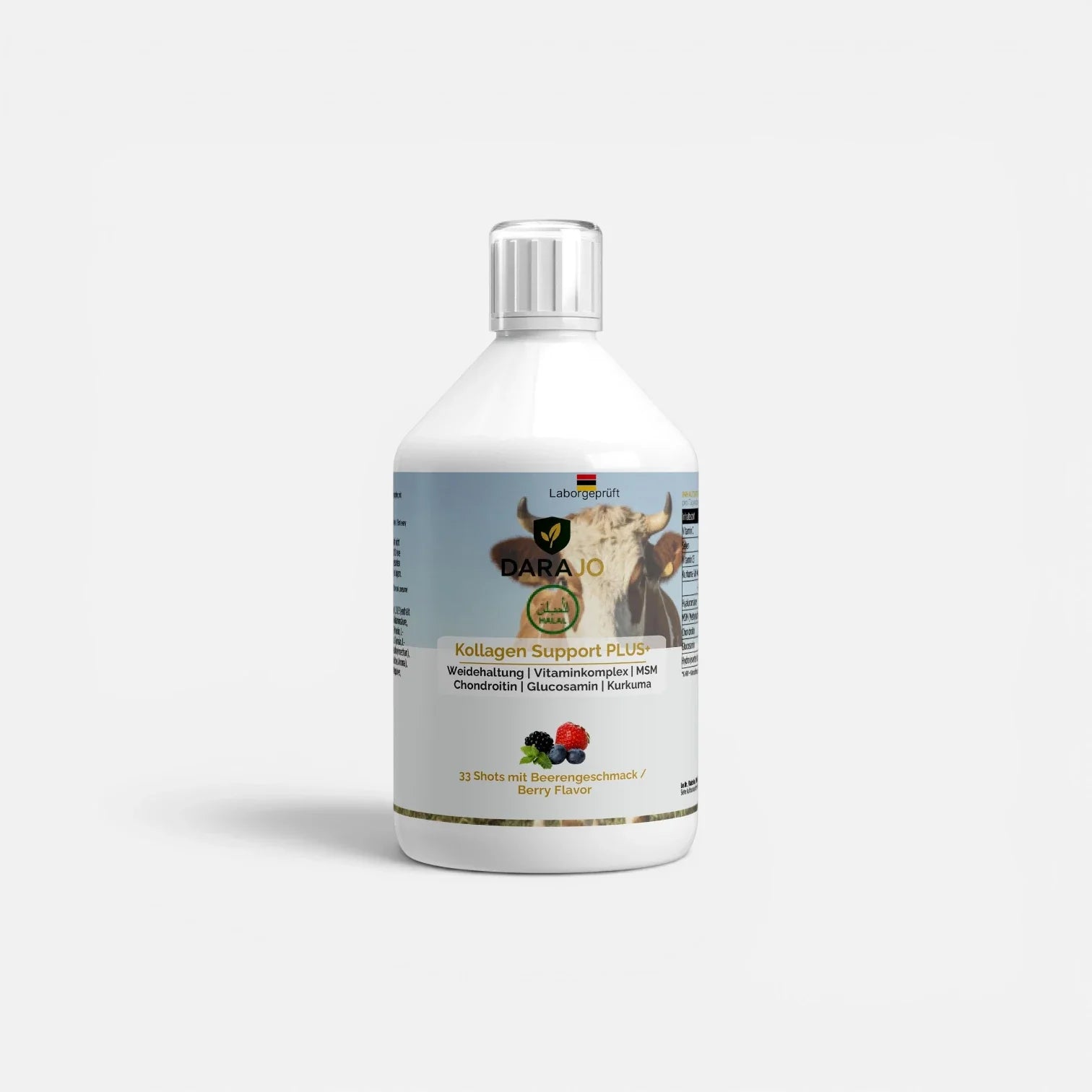
Kollagen Support PLUS+ — for skin and joints
Key feature: Grass-fed bovine collagen, Type 1, 2 & 3, plus MSM, glucosamine, chondroitin and hyaluronic acid — so it supports connective tissue and joints alongside your skin.
How to take: One 15ml shot daily. Halal certified and lab tested.
Not sure which to pick? Go marine for glowing skin, hair and nails; go Support PLUS+ if you also want joint support. Want both benefits in one routine, the Glow & Balance Bundle pairs collagen with vitamin D3 and ashwagandha and saves 25%.
I’ve tried a few collagens before but always worried about whether they were really halal. With Darajo I finally don’t have to guess — and my skin and nails actually look better after a couple of months.
Verified buyer · Kollagen Marine Plus
How to use it
Collagen is simple — the only thing that really matters is doing it daily. Take your shot in the morning on an empty stomach, keep it up without gaps, and give it a full eight weeks before you judge the results. Skin and nails renew slowly, so consistency does far more than any single large dose. Most people notice their skin feeling more hydrated and nails getting stronger around week three or four, with elasticity and glow becoming clearer by week six to eight.
Frequently asked questions
Is collagen halal?
It depends on the source. Pork collagen is haram. Bovine collagen is halal only if the cattle were halal-slaughtered and the product is certified. Marine (fish) collagen is halal by default. When in doubt, let third-party halal certification make the decision for you rather than the marketing on the front of the pack.
Is marine collagen halal?
Yes. Marine collagen comes from fish, which need no special slaughter, so it’s halal by default — which is why it’s often the simplest choice for halal shoppers. Still, choose a certified product to rule out non-halal processing aids or flavourings added during manufacturing.
Is bovine collagen halal?
Only when the cattle were halal-slaughtered (zabiha) and the product carries halal certification. Standard, uncertified bovine collagen should not be assumed halal, because ordinary cattle slaughter doesn’t follow the required method. The upside is that certified bovine gives you Type 2 collagen for joints, which marine doesn’t.
Is collagen haram?
Collagen is haram when it’s from pork, or from cattle that weren’t halal-slaughtered. It’s permissible when it’s certified marine or certified bovine. So the same ingredient can be haram in one tub and halal in another — the source and certification are what decide it.
How can I be sure a collagen is really halal?
Look for certification from a recognised halal authority, not just a “halal-friendly” label. A named certifying body means the source, slaughter, processing and packaging have all been checked, whereas a self-declared claim usually only covers the source — if it means anything at all. If a brand can’t point to who certified it, treat the claim as unverified.
How long does collagen take to work?
Most people notice changes in skin and nails after about 4–8 weeks of daily use, with results building the longer you stay consistent. Taking it at the same time each day matters far more than the exact hour, so pick a moment you’ll actually stick to.