Most supplements are not obviously halal or haram — the answer is hidden in the capsule, the coating and the processing. This is the guide to reading any of them.
Short answer: whether a supplement is halal rarely depends on the active ingredient — it depends on what surrounds it. Vitamins, minerals, plant extracts, even synthetic compounds are usually permissible. The problems come from a handful of hidden extras: gelatin capsules and gummies, animal-derived enzymes and colours, and alcohol-based flavourings. Learn to spot those, and you can check almost any supplement in under a minute.
This is the complete guide to halal supplements: what actually makes one permissible, the specific ingredients that quietly make one haram, how to read any label, and the halal status of every major supplement — each linked to a detailed breakdown. Whether you’re buying protein, vitamins or an adaptogen, this is the map.
Last updated: 17 October 2026 · By the Darajo team
What makes a supplement halal?
A supplement is halal when everything in it — and everything used to make it — is permissible under Islamic dietary rules. That means no pork, no alcohol, and no ingredient from an animal that wasn’t halal-slaughtered. The tricky part is that the active ingredient is almost never the issue:
- Minerals (magnesium, zinc, iron) come from mineral sources — halal by default.
- Vitamins are usually synthesised or plant-derived — the exception is the delivery, like a gelatin softgel.
- Plant extracts (ashwagandha, sea moss, shilajit) are halal as ingredients.
- Even most synthetic compounds (like creatine) are made without animals.
So the real question is never just “what’s the ingredient?” It’s “what’s the capsule made of, how was it processed, and what was added for colour and flavour?” That’s where the halal answer actually lives.
The hidden ingredients that make supplements haram
These are the extras to watch for — the ones that turn an otherwise-permissible supplement into a “check first” product. If you learn to spot just these, you’ve covered the vast majority of cases:
E-numbers to know: the cheat sheet
On European labels, many of these ingredients appear as an E-number rather than by name. These are the ones worth recognising on a supplement label:
| Code | What it is | Why to check | Status |
|---|---|---|---|
| E120 | Carmine / cochineal | Red colour made from insects | Avoid unless certified |
| E542 | Edible bone phosphate | Made from animal bones | Avoid unless certified |
| E471 | Mono- and diglycerides | Emulsifier from plant or animal fat | Check the source |
| E422 | Glycerol (glycerin) | Plant or animal fat – common in softgels | Check the source |
| E920 | L-cysteine | Can come from feathers or hair | Check the source |
| E904 | Shellac | Insect resin used as a glaze | Scholars differ |
| E1510 | Ethanol | Alcohol used as a carrier or solvent | Check the source |
Gelatin usually isn’t listed as an E-number – look for the word “gelatin” or “gelatine” itself. “Plant-based” or “vegan” next to an E-number generally settles the question.
Capsule, gummy, shot or powder? Formats compared
The fastest shortcut is the format itself. Some formats simply leave fewer places for a non-halal ingredient to hide:
| Format | What to look at | Risk |
|---|---|---|
| Liquid shots & drops | No shell at all – only the flavourings and carrier need a glance Darajo example: Kollagen Marine Plus → |
Low |
| Powders | No shell – check flavourings, and the enzyme source in whey Darajo example: Creatine Monohydrate → |
Low |
| Vegetable capsules | “HPMC” or “pullulan” on the label means a plant-based shell Darajo example: Shilajit Vegan Capsules → |
Low |
| Tablets | No shell, but coatings and colours can hide E120 or E904 Darajo example: Iron + Vitamin C → |
Low |
| Gummies | Pectin-based gummies are fine; gelatin-based ones need certification Darajo example: Ashwagandha + B6 Gummies → |
Check |
| Softgels | Almost always gelatin – only buy with halal-certified gelatin Darajo example: Omega 3 (halal gelatin) → |
High |
If you want the lowest-risk format by default, liquid shots are the easiest place to start:

Your halal daily routine
Liquid Essentials Bundle
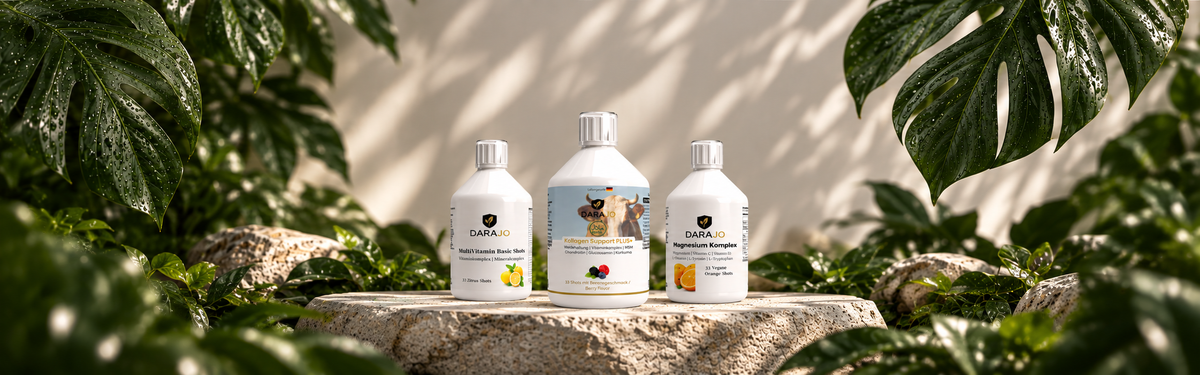
Kollagen Support, Magnesium Komplex and Multivitamin – three liquid shots, no capsule to check, one simple routine every morning.
€89.90€99.97
How to check any supplement label in under a minute
One routine works for almost every product. Run through it before you buy:
- Check the format. Liquids, drops and powders have no capsule shell. Capsules and gummies need checking; softgels are almost always gelatin.
- Read the capsule. You want “vegetable,” “HPMC” or “pullulan,” not plain “gelatin,” never “porcine.”
- Scan the colours and flavours. Watch for carmine (E120) and alcohol-based flavourings.
- Mind the special cases. Whey (rennet) and probiotics (growth medium) have hidden issues you can’t see — certification covers them.
- Look for a named certifier. A real halal claim names an issuer. A vague “halal-friendly” with no issuer is a soft claim, not proof.
Want to skip the check entirely? Browse our halal supplements – shots, powders, vegan capsules and pectin gummies.
Is it halal? Every major supplement, explained
Here’s the halal status of the most common supplements, each with a full breakdown of what to check and why:
Marine vs bovine, and the gelatin trap Is Creatine Halal?
Synthetic and permissible — with a catch Is Fish Oil Halal?
The oil is fine, the softgel isn’t Is Vitamin D3 Halal?
Source and softgel, explained Which Magnesium Is Best?
The forms that work — and the halal check Is Ashwagandha Halal?
Capsule, gummy and extraction Is Shilajit Halal?
Halal, plus purity and testing
The Darajo version of each:
 Kollagen Marine PlusCollagen · liquid shot · €39.99
 Creatine MonohydrateCreatine · powder · €34.99
 Omega 3 TriglycerideFish oil · halal gelatin · €24.99
 Vitamin D3 + K2Vitamin D3 · drops · €29.99
 Magnesium KomplexMagnesium · liquid shot · €24.99
 Ashwagandha + B6Ashwagandha · pectin gummy · €26.99
 ShilajitShilajit · vegan capsule · €32.99
Frequently asked questions
Are supplements halal?
Many are, but not automatically. The active ingredients are usually permissible; the risk is in the capsule, coating, colour, or how it was processed. Look for halal certification, which covers the parts you can’t see on the label.
What is the most common non-halal ingredient in supplements?
Gelatin. It’s used in capsules, softgels and gummies, and is often pork or from non-halal-slaughtered beef. Vegetable capsules and liquid formats avoid it.
Is gelatin halal?
Only if it comes from a halal-slaughtered animal and is certified. Pork gelatin is haram, and standard beef gelatin can’t be assumed halal without certification.
How do I know if a supplement is really halal?
Look for certification from a recognised halal authority — a named issuer, not just a “halal-friendly” label. Certification covers the ingredients, the capsule, the processing and the packaging.
Are vegan supplements automatically halal?
Usually, since vegan products contain no animal ingredients and no gelatin. The remaining thing to check is alcohol-based flavourings or solvents, which certification confirms.
Which supplement formats are safest for halal?
Liquids, drops, powders and vegetable-capsule products carry the least risk, because there’s no gelatin shell. Gummies and softgels are the ones to check most carefully.
How Darajo handles it
We built Darajo so you never have to run this checklist on our products. Our shots, drops and powders have no capsule at all. Our capsules use plant-based shells, our tablets are vegan and our gummies are made with pectin – and where a softgel needs gelatin, we use halal-certified gelatin. The point is simple: pick what you need for your goal, not for what happens to be permissible.
Your halal daily routine
Liquid Essentials Bundle
Kollagen Support, Magnesium Komplex and Multivitamin – three liquid shots, no capsule to check, one simple routine every morning.
€89.90€99.97
Prefer to build your own? Explore all halal supplements – pick any 3 and save 10% automatically.
For years I read every ingredient list and still wasn’t sure. Having a brand where everything is halal certified means I can just pick what I need and trust it — that peace of mind is the whole reason I switched.
Verified buyer · Darajo
Finally a supplement brand made for us — everything certified, nothing to second-guess, and the quality actually holds up. This guide alone taught me more than years of squinting at ingredient lists.
Verified buyer · Darajo