Vitamin D3 is one of the most important supplements — and one of the least obvious to buy halal. The source and the softgel are the two things to check.
Short answer: vitamin D3 can be halal, but it isn’t automatic. D3 is almost always made from lanolin (sheep’s wool) or from fish — both permissible sources — but the softgel it usually comes in is made from gelatin, which is often pork or non-halal beef. So the real question isn’t “is vitamin D3 halal?” — it’s where the D3 came from and what the capsule is made of.
Most people in northern countries are low in vitamin D, especially in autumn and winter, which makes D3 one of the most worthwhile supplements to take. But if you keep halal, “vitamin D3” on the label doesn’t tell you enough. This guide covers where D3 comes from, why the softgel is the real issue, how to check a label, and why a drop format sidesteps the problem entirely.
Where vitamin D3 comes from
Vitamin D3 (cholecalciferol) is almost always produced from one of two sources: lanolin, the oil from sheep’s wool, or fish. Both are considered permissible — the sheep isn’t slaughtered for lanolin, and fish needs no special slaughter — so the D3 itself is generally halal. (A newer vegan D3 from lichen also exists, but it’s less common.)
So the vitamin is rarely the problem. As with so many supplements, the issue is what the D3 is delivered in — and with vitamin D3, that’s very often a gelatin softgel.
The real issue: the softgel
Because D3 is fat-soluble, it’s usually sold as an oil-filled softgel — and a softgel is made mostly of gelatin. That’s where halal shoppers get caught out:
- Pork gelatin. The cheapest and most common softgel material, and clearly haram.
- Non-halal beef gelatin. Only halal if the cattle were halal-slaughtered and certified — standard beef gelatin usually isn’t.
- The source rarely stated. Most labels just say “vitamin D3” and “softgel,” with no mention of where either came from.
This is exactly why a “vitamin D3” claim doesn’t settle it. The two things that do are a permissible D3 source and a halal capsule — or a format that has no gelatin shell at all, like oil drops.
I never realised my old vitamin D was a gelatin softgel until I checked. Drops with just an oil base — no capsule to worry about — is exactly what I wanted for the whole family.
Verified buyer · Vitamin D3 + K2 Drops
Drops or softgels? The halal difference
With vitamin D3, the format decides how easy the halal question is. Oil drops have no gelatin shell at all, so there’s nothing to verify beyond the source. Softgels can be halal — but only if the gelatin is certified. Here’s the difference:
How to check a vitamin D3 label in under a minute
Two quick things — the source and the shell — tell you almost everything:
- Check the format. Oil drops and liquids have no gelatin shell; softgels do.
- For softgels, read the gelatin. You want “halal” or “halal-certified” gelatin — not just “gelatin,” never “porcine.”
- Look for K2. D3 works best paired with K2 (MK-7), which directs calcium to your bones.
- Check the strength. D3 is measured in IU or µg per serving — make sure the dose suits you.
- Find the certifying body. A named issuer means it’s been checked; a vague claim is not proof.
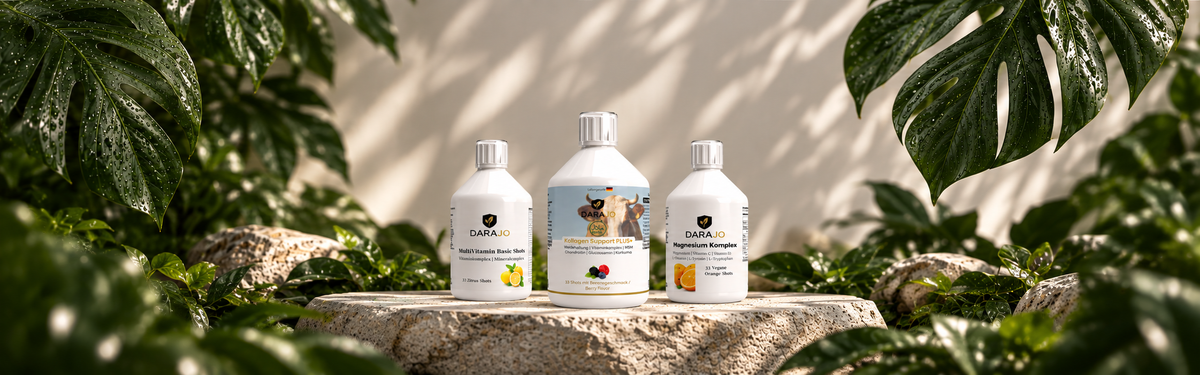
How Darajo handles it
We made our vitamin D3 as oil drops for exactly this reason — no gelatin softgel, so no capsule question — and paired it with K2 so the calcium goes where it should.
Vitamin D3 + K2 Drops — no capsule, no gelatin
Key feature: 1,000 IU vitamin D3 with K2 (MK-7) per drop, in a simple MCT coconut-oil base — no softgel, no gelatin, nothing to verify beyond the oil. D3 and K2 work together to support bone strength and cardiovascular health. 1,700 drops per 50ml bottle.
How to take: One drop daily with a meal — onto food, into a drink, or under the tongue.
One drop a day couldn’t be easier, and I feel noticeably better through the winter months now. Love that it’s just oil and vitamins — nothing I have to second-guess.
Verified buyer · Vitamin D3 + K2 Drops
How to use it
Take one drop daily with a meal that contains a little fat, since vitamin D3 is fat-soluble and absorbs best alongside food — drop it straight onto food, into a drink, or under the tongue. Morning is a good habit, but the exact time doesn’t matter; what matters is taking it every day, especially through autumn and winter when sunlight is scarce. Vitamin D builds up a steady level in your body over weeks, so consistency is what delivers the benefit.
Frequently asked questions
Is vitamin D3 halal?
It can be. D3 is usually made from lanolin (sheep’s wool) or fish, both permissible. The thing to check is the softgel — often gelatin — so choose a halal-certified capsule or a drop format with no shell.
Is vitamin D3 from lanolin halal?
Yes. Lanolin is the oil from sheep’s wool and the animal isn’t slaughtered for it, so D3 from lanolin is considered permissible. The remaining question is just the capsule it comes in.
Do vitamin D3 softgels contain pork?
They can. Softgels are made from gelatin, and the cheapest is pork. Look for halal-certified gelatin, or avoid the issue with oil drops.
Is vitamin D3 or D2 better?
D3 raises and maintains your vitamin D levels more effectively than D2, which is why most supplements — and this guide — focus on D3.
Why combine D3 with K2?
D3 increases how much calcium you absorb, and K2 (MK-7) directs that calcium into your bones and away from your arteries. Together they support both bone and cardiovascular health.
Can Muslims take vitamin D3?
Yes. As long as the D3 is from a permissible source and the format is halal — a certified capsule or a gelatin-free drop — vitamin D3 is fine to take.